Cloud diagrams
Cloud diagrams are AI diagrams generated from a connected data source. Reference an AWS account, an Azure subscription, a ServiceNow instance, or any other connected source in AI chat, describe what you want, and Eraser draws it from what it found in the last scan – not from a description of what should be there.
Before you start
- A data source has to be connected and Active in Settings → Data Sources. Each one has its own walkthrough – see Data sources.
- The first scan starts when you connect and takes a minute or two. Until it finishes, the data source cannot be used in a prompt.
Generating a cloud diagram
1. Open AI chat
A new chat opens on the screen below. Leave the prompt box empty for now – the reference menu only opens from an empty prompt.
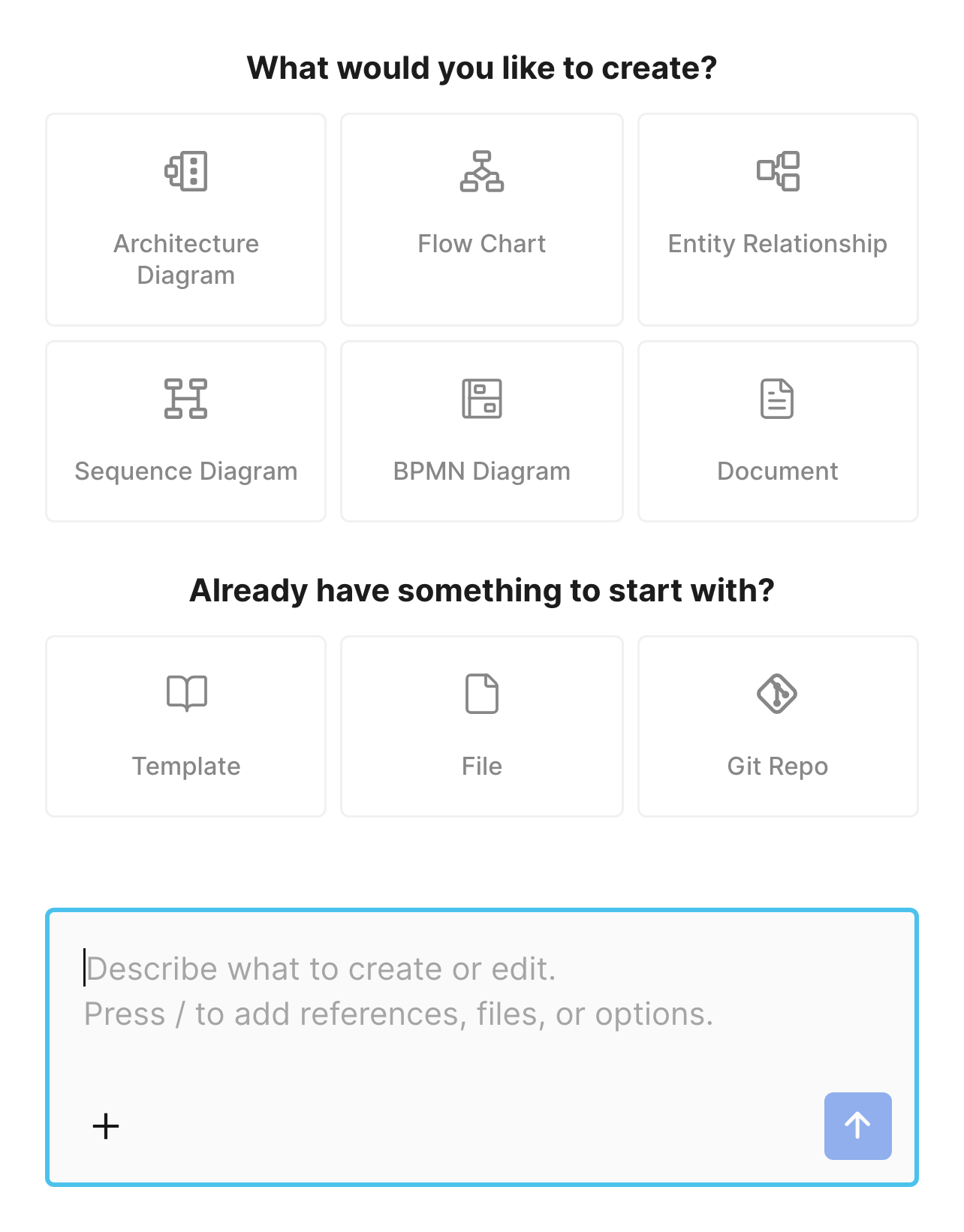
2. Add a data source
Press / to open the reference menu, then choose Data sources under Add Reference.
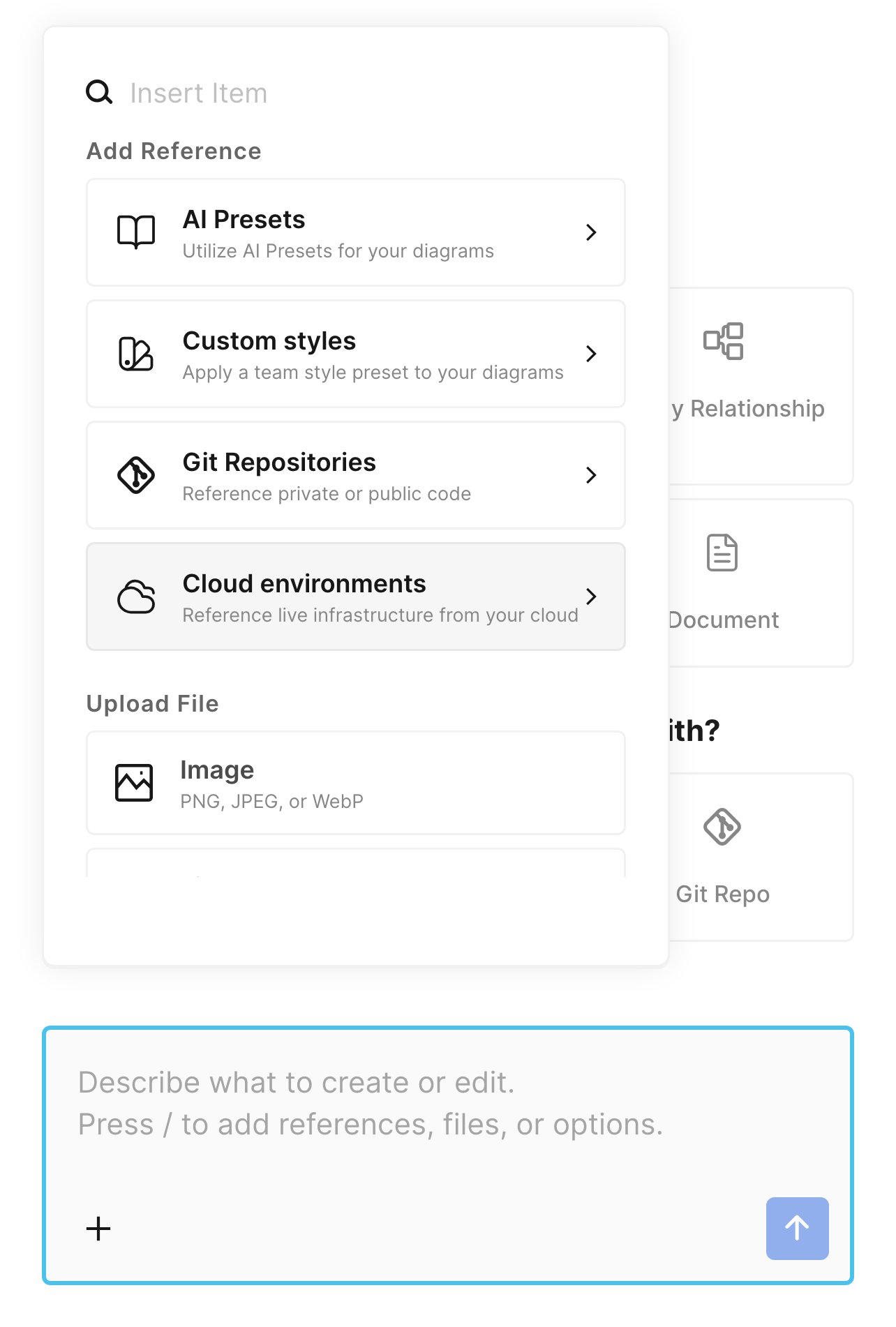
3. Pick the environment
Each entry is one environment – an AWS account, an Azure subscription, a Google Cloud project, a ServiceNow instance, a vCenter, a Cisco network or site, or an Ardoq workspace. A connection that covers several – an AWS organization, an Azure tenant, a set of vCenters – lists each one separately, with the connection it belongs to underneath.
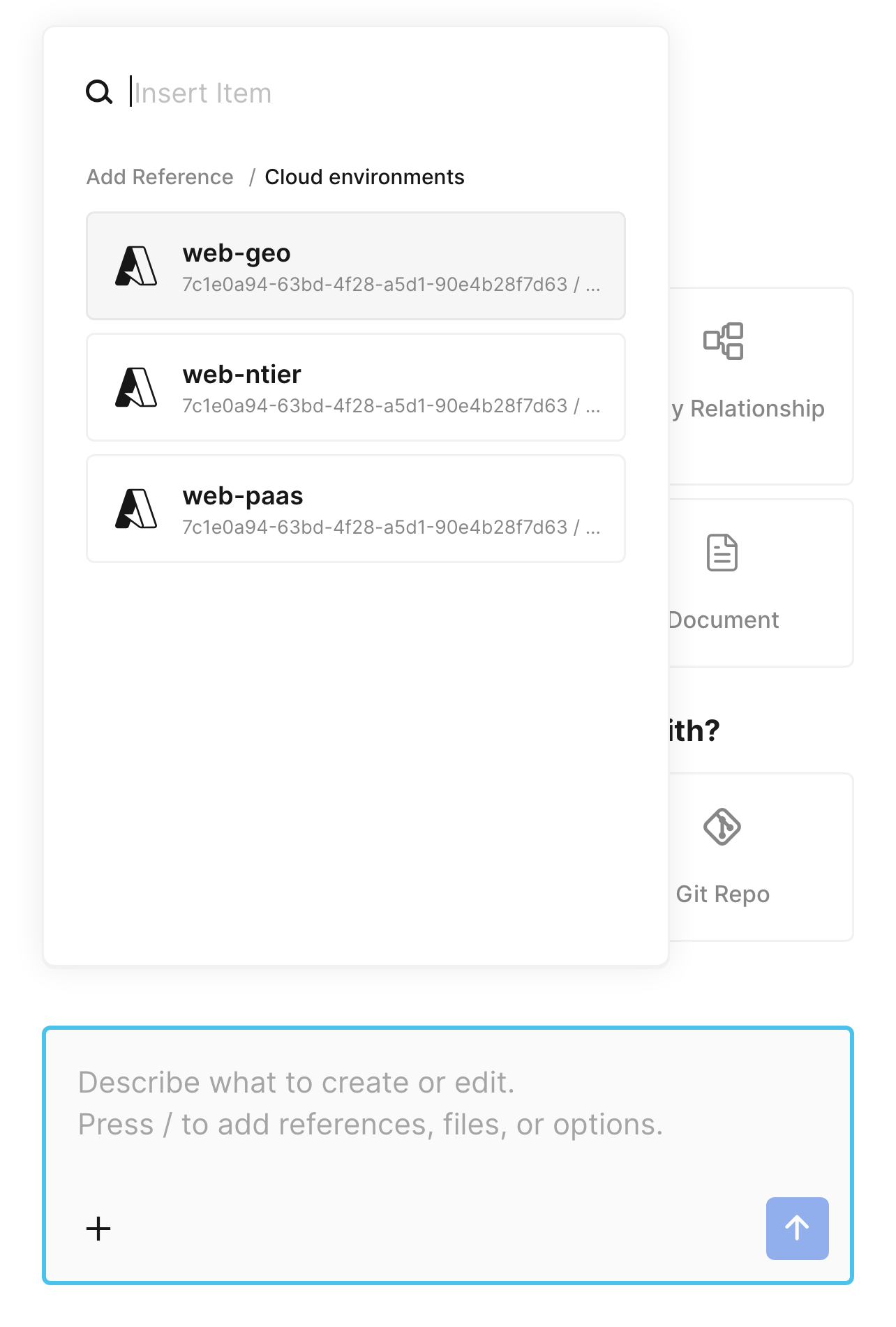
Only connections that are Active in Settings → Data Sources are listed. If the list is empty, nothing is connected yet.
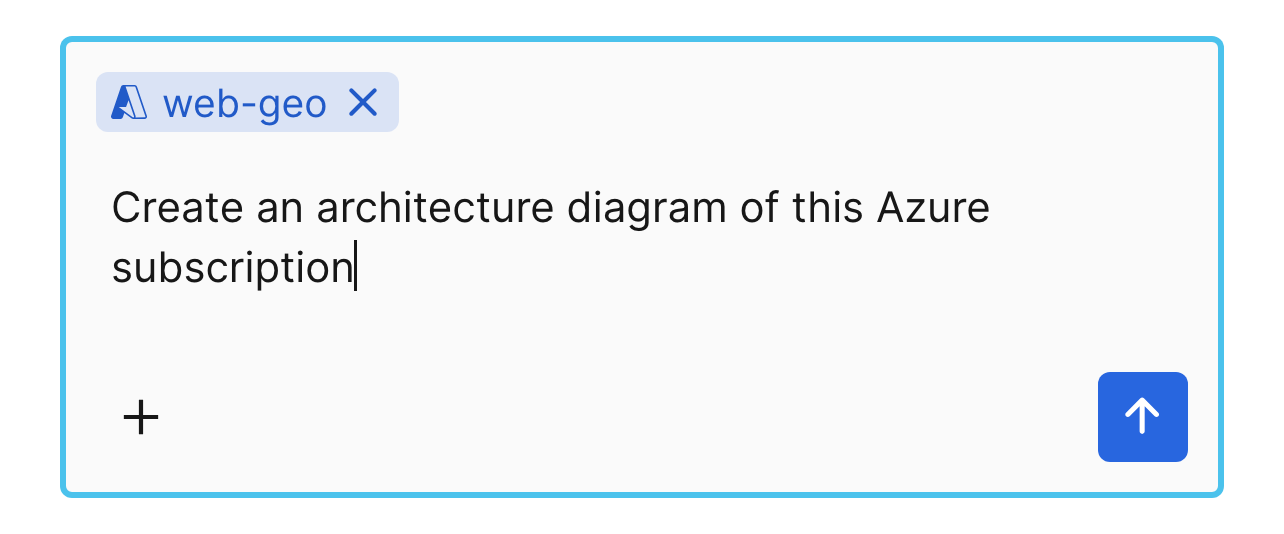
To include more than one environment, press / again and pick another. Each one appears as a chip above the prompt.
4. Describe what you want
Type your prompt and send it. Eraser reads the environment and draws the diagram.
What to ask for
Ask for the whole environment, or for one part of it. Naming what you are after gives the best results:
- “Create an architecture diagram of this Azure subscription”
- “Draw the VPC that contains the
ordersservice, with its subnets and load balancers” - “Diagram the
checkoutworkload – everything it talks to, and everything that talks to it” - “Draw everything deployed in
us-east-1” - “Show the network topology: VNets, peerings, and private endpoints”
- “Diagram the data stores in this project and which services connect to them”
- “Show what has access to the production database”
- “Diagram the
Checkoutapplication service from the CMDB, and the servers it runs on” - “Draw the Seattle HQ network: its switches, appliances, and how they are linked”
How Eraser reads the environment
Eraser reads the newest scan of the environment, not the live source. There is no scheduled background scan, so before generating a diagram that should reflect something you just changed, choose Rescan in Settings → Data Sources – or, for a VMware CSV, upload a new export.
Several environments can be attached to one prompt – two subscriptions, or an account and a project. Eraser reads each one and draws them together.
Refining the result
Keep prompting to change the result – add a service, drop a region, group things differently. AI presets and custom styles apply to cloud diagrams the same way they do to any other AI diagram: add them from the same / menu.
You can also ask for a document instead of a diagram – an inventory of what is deployed, or a description of how a workload is wired up – with the same environment attached.
Troubleshooting
| What Eraser says | What it means |
|---|---|
| … is still being scanned for the first time. Try again in a minute. | The first scan is running. Wait for it to finish, then send the prompt again. |
| No scan has been run for … yet. Run a scan of the account, then try again. | No scan has completed. Open Settings → Data Sources and choose Rescan. |
| … is not connected. Reconnect the account, then try again. | The credential no longer works – usually the role, app registration, service account, or token was removed. Reconnect the data source. |
| Scanning is turned off for …. Turn it back on, then try again. | The connection is set to Inactive. Set it back to Active in Settings → Data Sources. |
| Connect a data source to use as context. | The Data sources list is empty: nothing is connected, or every connection is inactive. Connect a data source, or reactivate one. |